A Monument of Charity: Rzeznik’s New Book Tells the Story of Compassion and Healing at St. Vincent’s Hospital
Thursday, April 30, 2026
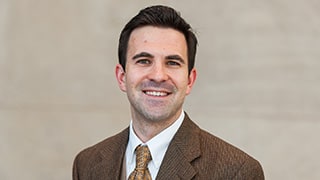
Thomas Rzeznik, Ph.D., Professor in the Department of History
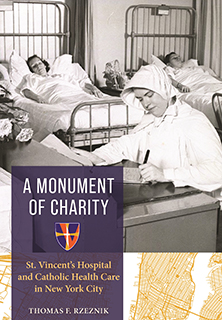
Seton Hall University celebrates the publication of A Monument of Charity: St. Vincent’s Hospital and Catholic Health Care in New York City by Thomas Rzeznik, Ph.D., a professor in the Department of History. The new book (forthcoming from NYU Press in June 2026) offers readers a richly textured account of healing and compassion. As a historian of American Catholicism, Rzeznik has long explored how religious institutions take shape within the social and economic realities of American life — a concern that has shaped his broader scholarship, including the books The Cambridge Companion to American Catholicism (Cambridge University Press, 2021) and Church and Estate: Religion and Wealth in Industrial-Era Philadelphia (Penn State University Press, 2013).
A Monument of Charity offers a deeply researched and engagingly written history of St. Vincent’s Hospital in New York City. Founded in 1849 by the Sisters of Charity of New York in the wake of a devastating cholera epidemic, the hospital was a sanctuary of healing for more than 160 years, a place where New York’s sick, poor, abandoned and suffering were received, nursed, accompanied, comforted and cared for with dignity.
 For Rzeznik, writing this book made St. Vincent’s a presence that stayed with him,
deepening his understanding of Catholic health care and the world that shaped it.
“I started the project more than 10 years ago,” he said, spending those years “digging
through institutional records, annual reports, ledgers and volumes and volumes of
correspondence.” He began writing in earnest “in the midst of the COVID epidemic,”
reflecting on cholera, AIDS and hospital care at a moment when the world was once
again confronting the realities of sickness, fear and isolation.
For Rzeznik, writing this book made St. Vincent’s a presence that stayed with him,
deepening his understanding of Catholic health care and the world that shaped it.
“I started the project more than 10 years ago,” he said, spending those years “digging
through institutional records, annual reports, ledgers and volumes and volumes of
correspondence.” He began writing in earnest “in the midst of the COVID epidemic,”
reflecting on cholera, AIDS and hospital care at a moment when the world was once
again confronting the realities of sickness, fear and isolation.
From years of research and reflection, A Monument of Charity invites readers into a history woven from medicine, finance, labor and faith. The hospital began in a rented townhouse with thirty beds, no running water, no bathing facilities, little heat and sisters sleeping on mattresses laid out on the floor. From these humble and uncertain beginnings, St. Vincent’s grew into one of the largest and most prominent Catholic medical centers in the United States. Its mission was simple and radical, shaped through daily acts of service: to care for all in need, regardless of race, creed or financial means.
This mission gives the book its emotional power. Rzeznik shows that healing extended beyond the defeat of disease. It also included easing loneliness, fear and pain and ensuring that the suffering person was seen, accompanied and recognized. As he reflects, healing meant “caring not just for the body, but also the soul,” a ministry meant “to provide pastoral care, to provide comfort and spiritual healing.” In this history, Catholic health care takes shape as a practice grounded in human dignity. As Rzeznik states, “Catholic health care has emphasized that health care is a human right.”
One of the book’s notable contributions is its recovery of women’s leadership in health care. “I elevate the work of the sisters as part of the story,” Rzeznik says, “because they were responsible for making St. Vincent’s what it was.” He brings into view labor long obscured behind institutional walls: the sisters moved across every dimension of hospital life — as administrators, nurses, pharmacists and clerks, while also working in kitchens, laundries and at the admissions desk. This breadth of responsibility, Rzeznik explains, brought them an “intimate knowledge of the hospital and its operations.”
A Monument of Charity thus reframes the Sisters of Charity beyond a single image of gentle devotion. They emerge as organizers, institution builders and visionary leaders whose authority was forged through their daily work across every level of the hospital — from bedside to boardroom. “The Sisters of Charity were not just nurses, but also CEOs,” Rzeznik emphasizes. “They were pioneers in organized charity.”
Running through the book is a deeper insight: charity endures when goodness is organized, sustained and given lasting form. The Sisters of Charity transformed compassion into institutional structure and structure into a citywide witness. Despite gendered limitations, the sisters’ religious vocation offered a form of authority, enabling them to challenge prevailing male dominance in the medical field. In Rzeznik’s account, the sisters stand as central actors — woman who negotiated, resisted, led and governed, shaping the development of American health care through their work and witness.
Their compassion also extended into public advocacy. “Catholic sisters become health care advocates and reformers,” Rzeznik says. “They insisted that the city pay its fair share to care for the indigent sick.” They “fought for adequate reimbursement rates” so care for the poor could be sustained. The book honors a form of charity strong enough to call on public institutions, insurers and health systems to recognize and take responsibility for the real cost of caring for vulnerable people.
Amid cholera epidemics, the Triangle Shirtwaist Fire, the Titanic, the AIDS crisis and the attacks of 9/11, St. Vincent’s stood where human need became most urgent. A Monument of Charity makes this legacy visible again. It is a history of a hospital; yet it is also an invitation to remember that medicine reaches its fullest meaning when every patient is treated as a guest, every worker’s labor is seen with dignity and every act of care becomes part of a larger human story.
With both scholarly depth and a steady tenderness, Rzeznik has produced a narrative that invites readers to see health care, women’s leadership and Catholic social witness anew. A Monument of Charity returns St. Vincent’s Hospital to memory and, in doing so, opens a space where the human meaning of healing can be encountered once again.
Categories: Faith and Service, Nation and World