Global Collaboration Drives Seton Hall Into 2026 Nature Index Through Fanli Jia's Research
Tuesday, April 21, 2026
 The work of Fanli Jia, Ph.D., associate professor in the Department of Psychology at Seton Hall University's College of Arts and Sciences, has achieved a significant milestone for the University. His participation in the
SCORE Project has resulted in a collaborative publication in Nature, the world's most influential scientific journal, marking Seton Hall University's
inclusion as an indexed institution in the prestigious Nature Index for 2026.
The work of Fanli Jia, Ph.D., associate professor in the Department of Psychology at Seton Hall University's College of Arts and Sciences, has achieved a significant milestone for the University. His participation in the
SCORE Project has resulted in a collaborative publication in Nature, the world's most influential scientific journal, marking Seton Hall University's
inclusion as an indexed institution in the prestigious Nature Index for 2026.
The article, titled “Estimating the analytic robustness of social and behavioural sciences,” brought together nearly 500 independent analysts who reexamined data from 100 studies. The findings revealed that in approximately “57 percent of the SCORE trials, all five independent analysis teams reached roughly the same result as the original study," highlighting the variability that can arise from different analytic approaches. Scheduled for publication on April 1, 2026, this work positions Seton Hall among a distinguished group of institutions recognized for contributing to high-impact research. The significance of the SCORE Project was further highlighted by The New York Times and Science on the same day, which highlighted the project's ambitious goal of predicting the robustness of scientific studies and its broader implications for improving research practices across disciplines.
 This milestone follows Jia's publication in Nature Human Behaviour, another prestigious journal within Nature portfolio. His article, “The tension between big team science and colonial power dynamics," has been featured by APA Division 52, Society for Global Psychology for its timely
analysis of equity in global research partnerships. In this article, Fanli Jia argues
that while "big team science” promises to globalize the social and behavioral sciences,
it risks perpetuating a neocolonial model unless fundamental reforms are implemented.
He identifies a common pattern: "scholars from the Global North often lead decisions
on theory and methodology, while researchers from the Global South are primarily engaged
as foot soldiers for data collection." A critical step toward true equity, he contends,
is to "actively support scholars from the Global South to lead these collaborations."
This milestone follows Jia's publication in Nature Human Behaviour, another prestigious journal within Nature portfolio. His article, “The tension between big team science and colonial power dynamics," has been featured by APA Division 52, Society for Global Psychology for its timely
analysis of equity in global research partnerships. In this article, Fanli Jia argues
that while "big team science” promises to globalize the social and behavioral sciences,
it risks perpetuating a neocolonial model unless fundamental reforms are implemented.
He identifies a common pattern: "scholars from the Global North often lead decisions
on theory and methodology, while researchers from the Global South are primarily engaged
as foot soldiers for data collection." A critical step toward true equity, he contends,
is to "actively support scholars from the Global South to lead these collaborations."
Jia's commitment to global and cultural psychology extends to his role as Editor-in-Chief of the Cultural Psychology section of Frontiers in Psychology, where he shapes the internationalization of research and teaching. He recently authored a landmark Specialty Grand Challenge article titled "Global minds and local contexts: grand challenges and emerging opportunities in cultural psychology," which outlines a vision for internationalizing psychology by moving beyond Western frameworks through research that incorporates diverse cultural perspectives and builds equitable partnerships across nations.
 Jia has also contributed to internationalizing psychology curriculum through his
work on the International Competences for Undergraduate Psychology (ICUP) model, led by his Seton Hall colleague Susan Nolan, Ph.D. This global initiative brought together 120 psychology educators from 47 countries
to develop foundational competences for undergraduate psychology education worldwide.
Their contributions to multiple ICUP publications including those on collaborative
processes, cultural responsiveness, and alignment with the UN Sustainable Development
Goals, have helped shape a framework that prepares students to understand psychology
as a worldwide endeavor, transforming how psychological knowledge is constructed and
applied across diverse cultural contexts.
Jia has also contributed to internationalizing psychology curriculum through his
work on the International Competences for Undergraduate Psychology (ICUP) model, led by his Seton Hall colleague Susan Nolan, Ph.D. This global initiative brought together 120 psychology educators from 47 countries
to develop foundational competences for undergraduate psychology education worldwide.
Their contributions to multiple ICUP publications including those on collaborative
processes, cultural responsiveness, and alignment with the UN Sustainable Development
Goals, have helped shape a framework that prepares students to understand psychology
as a worldwide endeavor, transforming how psychological knowledge is constructed and
applied across diverse cultural contexts.
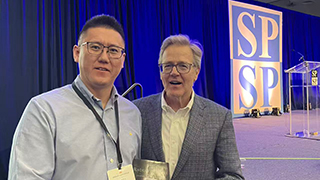
In early 2026, Jia was invited by APA Division 2, the Society for the Teaching of Psychology, to present a talk on “Global minds and cultural responsiveness: International Competences for Undergraduate Psychology (ICUP)” at the 48th Annual National Institute on the Teaching of Psychology. His presentation addressed strategies for preparing students to engage with psychological science as a culturally and globally inclusive discipline.
Jia serves as a core committee member of the Psi Chi Network for International Collaborative Exchange and contributed to the International Collaboration on Climate Change, whose influential article “Addressing climate change with behavioral science: A global intervention tournament in 63 countries” was published in Science Advances.
The Office of International Programs would like to feature faculty scholarship that has an international focus. Please share your global research news with us at oip@shu.edu.
Categories: Nation and World, Research, Science and Technology