Corrigan Hall, First Floor, to Undergo Renovation for New Laboratory and Instructional Spaces
Thursday, December 11, 2025
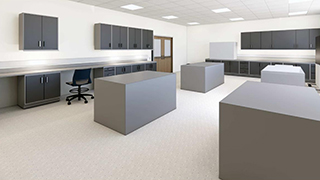
Semiconductor Laboratory (Credit: HLW Architecture LLC)
Beginning this spring, Seton Hall University will renovate part of Corrigan Hall’s first floor, converting former Information Technology (IT) office spaces into new research and training laboratory and instructional facilities, including a semiconductor plasma processing lab and an optics/laser lab to support teaching and research in applied physics and engineering and related STEM fields.
The renovation is being done to accommodate the new state-of-the art instrumentation supported by nearly $1 million in federal funding for semiconductor research. The grant through the National Institute of Standards and Technology (NIST) expands the University’s instrumentation infrastructure and capabilities to study how low-temperature plasmas (LTP) used in advanced manufacturing of current and next-generation semiconductor materials are used in the fabrication of microchips and microelectronics.
Once complete, the upgraded space will feature several new spaces, including:
- Semiconductor laboratory, which will house specialized equipment including plasma deposition systems used to process semiconductor materials
- Optics/Laser laboratory, with critical equipment to manipulate light and study light emission used in the fabrication of microelectronics
- Instructional and meeting lab, a multi-purpose, flexible training space connected to the semiconductor laboratory that can be used as classroom, training or conferencing space
- Student collaboration space, giving students a dedicated area where they have individualized workspaces for data analysis as well as space to work collaboratively on ongoing research
- Faculty offices, located adjacent to the labs
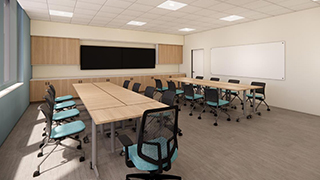
Multi-purpose Instructional and Meeting Lab (Credit: HLW Architecture LLC)
Building on long-term planning to expand science facilities into Corrigan Hall, the project will continue interdisciplinary and collaborative research among faculty and students in alignment with the strategic priorities laid out in Seton Hall’s new strategic plan, Inspiring Great Minds to Greater Purpose.
“This renovation is a long-term investment in the spaces where students and faculty research, teach and learn,” said Interim Provost Erik Lillquist, J.D. “By updating laboratories and creating facilities that mirror industry and advanced research settings, the project furthers the University’s commitment to providing transformative student experiences and driving academic innovation and research that address real-world challenges.”
With implications for microelectronics, nanofabrication and advanced manufacturing industries, the research aligns with the priorities outlined in the U.S. Creating Helpful Incentives to Produce Semiconductors (CHIPS) and Science Act, which aims to strengthen domestic semiconductor innovation and workforce development.
Undergraduate and graduate students in physics, chemistry and applied science and engineering will engage with the upgraded facilities, which will build on the existing research capabilities of the University’s Advanced Materials Synthesis and Characterization Laboratory and the Laboratory of Electrophysics and Atmospheric Plasma (LEAP).
“The facilities will allow students to work with the tools and technologies common in microelectronics and nanofabrication industries,” said Jose Lopez, Ph.D., director of the Office of Grants and Research Services and professor of physics.
The upgraded labs will also support research across the entire semiconductor development process, Lopez said, through the collaborative connections of his research combined with Professor Alper Sahiner, Ph.D., and Assistant Professor Jun Ouyang, Ph.D. Lopez explained:
My expertise is in low-temperature plasmas, which enables the processing and eventual fabrication of microchips and other semiconductor devices. Professor Sahiner is an expert in characterizing new semiconductor materials; understanding how the materials change after processing and how the different new materials can be used. All this is then bridged by Professor Ouyang’s expertise on the integration and development into actual microchips and other microelectronic devices.
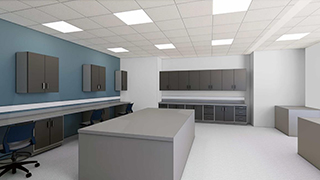
Optics/Laser Laboratory (Credit: HLW Architecture LLC)
Both the semiconductor and optics/laser laboratories will function as clean labs, each following cleanroom protocols before researchers step into the lab spaces. There will be a cleaning and vestment entry area to the labs to help maintain a controlled clean research environment, minimizing airborne particles and other environmental variables that can interfere with experiments.
Jonathan Farina, Ph.D., dean of the College of Arts and Sciences, added:
Corrigan Hall’s renovation strengthens Seton Hall’s physics and engineering programs by creating new research and learning facilities for students in high-demand, STEM fields. The new labs with industry-aligned equipment will provide more students the kinds of hands-on experiences that Seton Hall is committed to providing, and they do so at a pivotal moment in the growing fields of computer engineering, materials science, green energy and more.
Construction-related activities will begin in January 2026 and continue through the spring and summer semesters. The project is expected to be completed in September 2026. Classrooms and offices in other areas in Corrigan Hall will not be affected during the renovation.
In addition to the upgrades on the first floor, the project will also include renovation of office space on the lower level of Corrigan Hall, made possible in part by the forthcoming relocation of select Information Technology services with the creation of the Innovation Hub in Walsh Library.
At the start of the spring semester, members of the campus community can visit the Innovation Hub's Solutions Studio on the first floor of Walsh Library for in-person help with laptop assistance (hardware and software), issues with logging into the SHU network (Wi-Fi or account access) and general questions regarding University technology.
- For questions regarding construction, please contact facilitiesengineering@shu.edu.
- For questions regarding safety and security, please contact publicsafety@shu.edu.
- For all other related questions, please contact communications@shu.edu.
Categories: Campus Life