Inside the Core: 'The Lord of the Rings' and Papal Encyclicals
Monday, October 19, 2026

Inside the Core this week we are hosting the first of three events involving papal encyclicals. The first event is part one of the screenings of The Lord of the Rings: the Return of the King, the film version of the third book in J.R.R. Tolkien’s classic trilogy from 6 to 8 p.m., Tuesday, October 20, in the Campus Ministry Lounge in Boland Hall.
The second part of the film will be screened on Tuesday, October 27, same time, same place. These screenings, co-hosted by Campus Ministry and the English Club, along with the Core, will be introduced by a student or faculty scholar, linking the film and text to Pope Francis’ Laudato Si.
The third event, also involving a papal encyclical, occurs from 2 to 3:15 p.m., Thursday, October 29, in Schwartz, Room 102, where we will host a panel of faculty experts who will discuss Pope Leo XIV’s encyclical Magnifica Humanitas, dealing with AI and its ethical, moral and human implications.
Panelists are Father Joseph Laracy, STD; Jose Lopez, Ph.D., Department of Physics; and Kelly Shey, Ph.D., Department of English. Besides being linked by the fact that both events are connected to papal encyclicals, there is an interesting connection beyond that obvious one and it is definitely worth exploring and that connection is – J.R.R. Tolkien himself.
J.R.R. Tolkien, a devout Catholic, brings faith into his epic fantasy in many ways, saying once in a letter to Father Robert Murray that The Lord of the Rings is "of course a fundamentally religious and Catholic work; unconsciously so at first, but consciously in the revision" (1953). The depth of the story’s morality, its critique of the wrong use of power and idolatry of power and the over-arching sense of providence all link to the author’s deeply held Catholic world view. Part of that is the reverence the trilogy shows for nature, from the beginning to the end. It is this particular aspect of LOTR that our two screenings will address, as we link them with Pope Francis’ Laudato Si.
Just as Pope Francis called exploitation of the earth in the interests of power and greed sinful, something actually evil, so Tolkien depicts all good characters (Hobbits, Elves, good Wizards like Gandalf and others) as showing reverence for nature, seen not as a tool, but as a creature of a benevolent Creator. Evil characters (Sauron, the actual Lord of the Rings; Saruman, the corrupted Wizard influenced by Sauron; Orcs) all disdain nature, using it only as a tool to be destroyed in pursuit of their own goals of power and domination of others. Sometimes these evil characters, particularly Orcs, destroy the natural world simply for fun. Our viewing of the film will be in light of this particular lens regarding nature and Pope Francis’ Laudato Si.
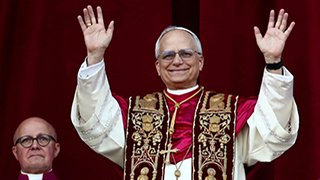 The other event involving a papal encyclical is our upcoming panel on Pope Leo XIV’s
Magnifica Humanitas. Our faculty experts will be exploring the important message conveyed by the Holy
Father in his response to artificial intelligence. They represent a variety of disciplines
(theology, science and English), but they are all interested in the moral and spiritual
content in the encyclical and how it applies to our world.
In Pope Leo’s deep and profound critique of AI and its implications for humanity, he raises questions regarding its use and misuse, including its having been programmed in a way that reflects the morality or lack thereof in its creators. Does AI reflect the values in Catholic social teaching, for example? The encyclical explores the many ways AI as it is currently created and used, does not. Apparently objective, AI’s answers regarding essentially moral questions involving equity and even issues of peace and war do not necessarily reflect an awareness of or a reverence for human dignity.
Pope Leo cautions how AI can create and even enhance systemic biases in terms of credit worthiness, mortgages given and other economic decisions, as well as being used in wars in a way that distances decisions from their human and moral repercussions. Though he is certainly not saying all use of AI is wrong or discounting the possibility of its being used for some good purposes, he cautions against using it carelessly, arguing against the use of AI in lieu of taking the time for critical thought and moral reflection, or spiritual inspiration. Clearly, he shows that AI requires vigilance and thoughtful monitoring and, this author would argue, not simply by those who can most benefit by its use.
How does this discussion relate to Tolkien or LOTR? For one thing, Tolkien’s critique of power and its misuse discussed in terms of nature with regard to Laudato Si, also connects powerfully with Pope Leo’s concerns regarding AI. Interestingly, one large AI giant, Peter Thiel’s Palantir, takes its name from the “Palantiri” or “Seeing Stones” in LOTR. There is an irony about naming a data analysis company dealing with artificial intelligence after these devices as they are associated with the obtaining of knowledge in connection with its leading to corruption and destruction in LOTR. Though, like AI, a Palantir can be used for good purposes if the use is by someone who is wise and able to handle it with the caution it warrants (such as Aragorn, who uses a Palantir without danger though he does so with some difficulty in Return of the King), for most characters, the corrupting influence of the Palantir, influenced by Sauron, leads to their being ultimately led into evil and, in some cases, destroyed.
We see this with once good Wizard Saruman, who is seduced through Sauron’s influence (in part through his unwise use of the Palantir) and in the case of Denethor, Steward of Gondor, who is led into prideful despair by the selective and deceptive glimpses of “truth” shown to him through the Palantir he habitually consults. Both figures are corrupted and then led to destruction by their use of this device in their desire for knowledge and ultimately of power. Pope Leo does not reference the Palantiri in his encyclical regarding AI, but the warnings implicit regarding them in LOTR relate powerfully to unwise and morally unclear uses of AI.
However, though he does not specifically refer to the Palantiri, in his encyclical Pope Leo does reference the LOTR, quoting the character Gandalf in Chapter 5, “The Culture of Power and the Civilization of Love,” section 213:
The twentieth-century Catholic author J.R.R. Tolkien, in the words of a protagonist in one of his novels, described our responsibility in this way: “It is not our part to master all the tides of the world, but to do what is in us for the succour of those years wherein we are set, uprooting the evil in the fields that we know, so that those who live after may have clean earth to till.” [187] The civilization of love will not arise from a single or spectacular gesture, but from the sum total of small and steadfast acts of fidelity that serve as a bulwark against dehumanization. For this reason, it is worthwhile pausing to reflect on some aspects of how we, each in our own way, can cooperate in building the civilization of love.
Tolkien would have been pleased to have been quoted by these Popes, not only because he was a devout Catholic, but because the values of which they are speaking are the threads that tie all his works together. Power must be used to serve people (in Tolkien’s case, humans, elves, dwarves and hobbits), not the other way around. Nature is to be reverenced, not used and abused to serve the ends of malevolent power grabs. War is not something to be glorified but undertaken only to defend the weak who are being attacked. These are basics of Catholic social teaching, reflected by these two Popes and by J.R.R. Tolkien.
Categories: Arts and Culture, Community Engagement, Faith and Service