Faculty Showcase Virtual Reality Innovation in Nursing
Thursday, December 11, 2025
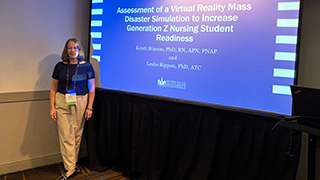
Kristi Stinson presented interdisciplinary research at Transform 2025, sharing how collaboration across health professions is shaping the future of nursing education.
Seton Hall University’s College of Nursing was featured at the American Association of Colleges of Nursing (AACN) Transform 2025 Conference, where Interim Dean Kristi Stinson, Ph.D., delivered a podium presentation on her collaborative study, Assessment of a Virtual Reality Mass Disaster Simulation to Increase Generation Z Nursing Student Readiness. The project, which was co-led with Leslie Rippon, Ph.D., associate professor, M.S. in Athletic Training, highlights the growing momentum behind immersive, technology-enhanced teaching strategies in nursing education.
Stinson and Rippon’s interprofessional collaboration was central to the project’s success. By integrating expertise in nursing, interprofessional communication, athletic training and simulation, the team developed a realistic virtual reality (VR) experience that allowed senior nursing students to make rapid triage decisions and team communication skills under the pressure of a simulated mass-casualty incident.
Their study found that VR-based simulation significantly improved students’ perceived readiness, interprofessional communication skills and confidence in disaster response frameworks. This finding is notable, as Generation Z learners increasingly seek technology-driven, immersive educational environments.
“Presenting at AACN Transform 2025 was an incredible opportunity to highlight the innovative work happening at Seton Hall,” said Stinson. “Sharing our findings with colleagues from across the country reinforced the importance of interprofessional collaboration and the powerful role virtual reality can play in preparing the next generation of nurses.”
The research illustrates how VR can bridge gaps in traditional emergency preparedness training while meeting the evolving learning needs of future nurses. The collaborative work of Stinson and Rippon demonstrates how cross-disciplinary innovation can elevate nursing education and better prepare graduates for complex clinical challenges.
Categories: Health and Medicine