Seton Hall Alumnus Launches Nonprofit Focused on Information Integrity
Wednesday, October 7, 2026
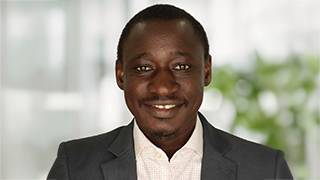
Seton Hall Alumnus and TTPI Founder Kebba Jeffang
In an era of digital media and artificial intelligence, misinformation and disinformation can spread rapidly, making information integrity more important than ever. Meet Kebba Jeffang, M.S. ’26, an alumnus of Seton Hall College of Human Development, Culture, and Media (CHDCM), who is championing this cause through his newly launched The Truth Protocol Initiative (TTPI).
Based in Washington state, TTPI promotes AI literacy, media literacy and information verification by empowering students, educators, librarians, election officials, journalists, civic organizations and community members.
Jeffang’s TTPI evolved from his capstone project, which he completed as part of the requirements for his M.A. in Professional Communication and Digital Media Arts. The project was inspired by more than a decade of experience as an investigative journalist, fact-checker and media literacy educator in The Gambia, West Africa.
Upon graduation, Jeffang implemented the TTPI in Washington State where he began building local partnerships with relevant state institutions, including the Spokane Public Library (SPL). The Spokane Public Library agreed to host TTPI programs and collaborate on initiatives aligned with the organization's mission, including a potential joint grant application later this year.
“I came to graduate school believing that information integrity should be a civic competency, not an elite science,” said Jeffang. “My desire to translate that philosophy into practice led me to research and develop a toolkit to protect U.S. elections from machine-made misinformation similar to what I did in The Gambia a few years ago. To take that research to where it is needed, I launched The Truth Protocol Initiative (TTPI).”
Jeffang said launching the TTPI has fulfilled his dream of institutionalizing his graduate capstone, saying he looks forward to offering free, practical AI and media literacy training to schools, libraries and communities across Washington State.
Jeffang credits CHDCM faculty and staff for providing guidance and support throughout his graduate studies, especially capstone adviser Ruth Tsuria, Ph.D.; committee members Renee Robinson, Ph.D., and Jess Rauchberg, Ph.D.; and academic adviser Brittany Ricci, M.A.
About Kebba Jeffang
A Gambian-born journalist based in the United States, Jeffang previously served as
a senior investigative reporter and head of media monitoring and fact-checking at
the Open Media Center in The Gambia. While at this center, he led a UNESCO-funded
Media and Information Literacy initiative to train 200 Gambian high school students,
leading to the development of a national training manual for the country’s National
Youth Council (NYC). In 2022, he was selected by the U.S. Embassy in Banjul to participate
in the Edward R. Murrow Program for Journalists in the United States.
About the College of Human Development, Culture, and Media
Launched in summer 2023, Seton Hall’s College of Human Development, Culture, and Media
embodies the University’s commitment to pedagogical innovation, intellectual ferment
and community engagement. Uniting scholars and students from four dynamic departments
— Communication, Media and the Arts; Education Leadership, Management and Policy; Educational Studies; and Professional Psychology and Family Therapy — the college is the new home of cutting-edge, transdisciplinary inquiry into the
stickiest problems of our time.
The faculty, staff and students of the college seek to improve the human condition by collaborating across distinct fields that uniquely complement one another, thereby preparing the next generation of dynamic leaders poised to tackle contemporary social challenges and opportunities. Expression underpins all facets of the integrated college’s portfolio — media as a form of education and artistic expression; teaching and learning as modes of creative expression; expression and expressibility as critical to counseling and therapeutic treatment; and self-expression as a vehicle of social agency.
Categories: Alumni, Science and Technology