A World in Crisis: 8-hour Simulations Put Students Under Real-World Pressure
Tuesday, November 24, 2026
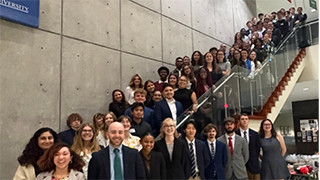
"Nile on the Break" group photo.
Two students, dressed in business attire and holding walkie-talkies, gesture a third student into the hallway. “You have been assassinated,” they tell him.
This exchange represents only one of many hallway updates that occurred during two separate international crisis simulations at Seton Hall University on October 3 and November 7. Each spanning eight hours, with the first including over fifty people and the second including over seventy, the simulations forced students to balance international tensions with domestic pressures as unexpected in-game events unfolded throughout the day – events such as the assassination of the Philippines team president.
Both simulations followed a similar format to previous iterations hosted by the Serviam Institute of International Security (SIIS). Students were divided into teams, assigned individual real-life positions and given detailed preparation materials. Over eight turns, teams debated decisions and typed descriptions of their desired actions into Providence, a digital platform that helps SIIS simulation controllers adjudicate team moves and allows the simulation to adapt and advance based on participants’ unique decisions.
The October 3 simulation, titled “Pressure Point,” unfolded in the South China Sea of 2029. While Taiwan often finds itself at the center of South China Sea discussions, SIIS aimed to expose students to other international dynamics shaping the region. The simulation featured nine teams: China, Indonesia, Malaysia, the Philippines, Singapore, Thailand, the United States, Vietnam and the Golden Dragon crime syndicate. At 8 a.m. sharp, students entered their assigned rooms in Jubilee Hall and received the first in-game update.
The Hubei, a Chinese Type 075 amphibious assault ship, was reported to have sunk approximately eighteen nautical miles northwest of the Swallow Reef, an atoll located in the Spratly Islands that is administered and occupied by Malaysia but also claimed by the People’s Republic of China. The cause of the ship’s sinking remained unknown to teams and as Chinese escort units moved to enforce a cordon around the area, teams found themselves faced with incomplete information and growing concerns of widespread conflict over territorial sovereignty.
From the beginning, contrasting personal goals sparked internal team conflict. On Team Philippines, the Secretary of National Defense pushed for a closer U.S.-Philippines alliance, while the Secretary of Foreign Affairs fought to minimize unnecessary publicity and the Executive Secretary aimed to avoid excessive financial costs.
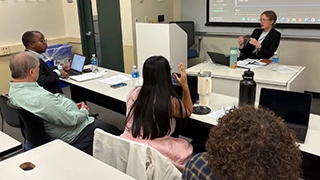
The Singapore team debates its next actions.
Team Singapore saw a similar scene unfold. Sydney Grieshaber, a second-year international relations and economics student assigned the role of Singaporean Prime Minister, remarked, “I really appreciated how dedicated my team members were to their roles. Everyone was well prepared, so our debates got heated at a few points, but I think that made it more realistic and more fun.”
A month following “Pressure Point,” focus shifted from the South China Sea to the Horn of Africa, where problems of water security, international conflict and humanitarian aid collided to set off a regional emergency. The November 7 simulation, dubbed “Nile on the Brink,” marked a significant increase in the number of participants and saw experienced professionals — such as War on the Rocks Assistant Editor Madeline Field and Seton Hall Professor Joseph Huddleston — working alongside students to tackle a variety of crises. “Nile on the Brink” also introduced international organization teams, as participants assigned to Amnesty International and the African Union joined those on the teams of Ethiopia, Eritrea, Egypt, Sudan’s Sudanese Armed Forces (SAF), Sudan’s Rapid Support Forces (RSF) and the Tigray People’s Liberation Front (TPLF).
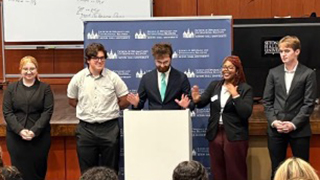
The African Union team delivers a final speech during closing remarks.
The simulation kicked off with a sudden surge of water released from the Grand Ethiopian Renaissance Dam (GERD), damaging infrastructure and displacing thousands of people. Information asymmetry, combined with a history of regional criticism towards Ethiopia’s construction of the GERD, meant high international tensions on top of domestic instability.
In order for the simulation to run smoothly on such a large scale, each team was designated a SIIS student fellow to act as team controller. These students enforced simulation rules, answered participant questions and communicated with the senior controllers. The senior controllers, two student fellows who ran the Providence adjudication, used a bird’s-eye-view to ensure narrative consistency and pace across eight turns. They also sent team-specific decision points throughout the simulation, forcing teams to debate and form a response before the turn-timer hit zero.
Egypt’s Minister of Finance, second-year international relations student Carly Hunter, commented on her experience with decision points. “About halfway through the simulation, our team had to make a pivotal choice – whether or not to support the TPLF in its conflict with Ethiopia. I vehemently voiced my opinion against supporting the TPLF, for such an endeavor would be costly. Even so, the diplomatic and strategic advantages of supporting the TPLF outweighed my opinion.”
Many students return repeatedly to take part in SIIS simulations. First-year Ashika Patel described her own takeaways as a new participant. “My first simulation was an amazing learning experience. Until that point, I had never gotten to experience live debate and discussion under constraints and unknowns. Partaking in the simulation allowed me to understand certain dynamics when it comes to dialogue between nations that can’t be taught in a classroom.”
Working in partnership with Seton Hall research group DiploLab, SIIS is examining the educational impact of its simulations. Across the October 3 and November 7 exercises, 79 post-simulation survey responses were collected, with every respondent identifying at least one skill they gained or strengthened. Students highlighted improvements in negotiation, mediation, communication and analytical skills. But perhaps the most important skill and one much harder to measure, is the ability to make decisions under pressure.
Multiple responses also highlighted the press briefing period, a set time in between turns when select representatives from teams met to present public statements designed to reassure their constituents and project calm amidst crises. Similar to real-life press conferences, the briefings were made more difficult when students from the Media Team acting as reporters called out speakers on slips of the tongue and questioned them on gaps in information.
Professor Brendan Balestrieri, the director of SIIS, explains, “I believe this is the future of experiential education. Students want to be challenged and they deserve opportunities to apply what they've learned in situations where information is incomplete, there are no clear answers and decisions have consequences. We're not simply teaching students about the challenges they'll face in the world. We're giving them the opportunity to practice confronting those challenges before the stakes are real.”
Keep an eye out for SIIS spring simulations and events by following the institute’s Instagram @setonhall_serviam.
Categories: Campus Life, Nation and World