La'Tesha Sampson, Ph.D., Recognized for Advancing Mental Health, Domestic Violence Advocacy and Social Justice
Thursday, October 15, 2026
 At the intersection of scholarship, public policy, mental health and social justice
stands La'Tesha Sampson, Ph.D., director of the Master of Social Work (M.S.W.) and Master of Public Administration (M.P.A.) programs at Seton Hall University. Her recent accomplishments — including the publication
of her book My MOM Is My BIGGEST HATER, legislative recognition for her contributions to domestic violence policy and recognition
as Health Educator of the Year—reflect a career dedicated to transforming personal
experiences, professional expertise and research into meaningful social change.
At the intersection of scholarship, public policy, mental health and social justice
stands La'Tesha Sampson, Ph.D., director of the Master of Social Work (M.S.W.) and Master of Public Administration (M.P.A.) programs at Seton Hall University. Her recent accomplishments — including the publication
of her book My MOM Is My BIGGEST HATER, legislative recognition for her contributions to domestic violence policy and recognition
as Health Educator of the Year—reflect a career dedicated to transforming personal
experiences, professional expertise and research into meaningful social change.
Turning Personal Experience Into Scholarship and Healing
 In her book, My MOM Is My BIGGEST HATER, Sampson explores the often-unspoken complexities of mother-daughter relationships,
particularly the emotional consequences of maternal criticism, rejection, unhealthy
family dynamics and the absence of nurturing support.
In her book, My MOM Is My BIGGEST HATER, Sampson explores the often-unspoken complexities of mother-daughter relationships,
particularly the emotional consequences of maternal criticism, rejection, unhealthy
family dynamics and the absence of nurturing support.
The book challenges the assumption that all maternal relationships are inherently safe and supportive, creating space for conversations about emotional wounds, generational trauma, boundaries, self-worth and healing.
Drawing upon her experiences as a psychotherapist, scholar, educator and woman, Sampson encourages readers to examine how early relational experiences can shape identity, mental health, interpersonal relationships and personal development.
This book is deeply meaningful to me because it gives language to experiences that so many people have endured in silence. We often talk about healing from trauma without fully acknowledging that some of our earliest emotional wounds can come from the very relationships where we expected to feel safest. My hope is that this book empowers people to recognize those wounds, release shame, establish healthy boundaries and understand that their beginnings do not have to determine their endings.
Beyond its personal significance, the book contributes to broader conversations within social work about family systems, trauma-informed care, intergenerational patterns and culturally responsive mental health practice.
Advancing Domestic Violence Policy Through Legislative Advocacy
Sampson impact also extends into New Jersey's legislative arena, where she contributed to advocacy surrounding legislation signed into law by Governor Phil Murphy that allows a history of domestic violence to be considered in certain sentencing decisions.
In recognition of her work on this issue, she received a legislative citation acknowledging her contributions to domestic violence advocacy and public policy.
The legislation highlights the importance of considering the experiences of survivors whose histories of abuse may provide essential context within the criminal justice system.
For Sampson, this work illustrates why social workers and public administrators must participate in policy development rather than simply respond to the consequences of existing systems. She explained,
Social workers understand the human impact of trauma, while public administrators have the opportunity to shape the systems and policies that respond to it. When we bring these disciplines together, we can move beyond identifying problems and begin changing the structures that perpetuate harm.
Her advocacy demonstrates the relationship between clinical knowledge, legislative engagement, criminal justice reform and the implementation of public policy.
Recognized for Leadership in Mental Health Education
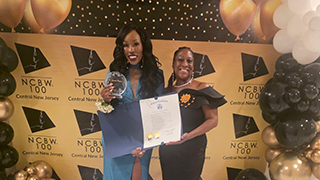
Sampson was also named Health Educator of the Year by the National Council of Black Women, recognizing her contributions to mental health education, advocacy and community wellness.
Her achievement was further acknowledged through a citation from the New Jersey General Assembly, recognizing her leadership and service in advancing mental health awareness and education.
As a licensed clinical social worker, educator and founder of Great Joy Counseling and Consulting Services and Great Joy Community Development Corporation, Sampson has worked to expand access to behavioral health resources, promote culturally responsive care and address disparities affecting historically underserved communities.
Her work bridges clinical practice, higher education, nonprofit leadership and community engagement — demonstrating that mental health education is both a public health priority and a public service responsibility.
Preparing the Next Generation of Social Workers and Public Administrators
At Seton Hall, Sampson brings these experiences directly into her leadership of the M.S.W. and M.P.A. programs.
Her interdisciplinary approach emphasizes the relationship between direct practice and systems-level change. She encourages students to recognize that meaningful service requires not only compassion and technical expertise but also ethical leadership, critical thinking, policy literacy and a willingness to challenge inequitable structures.
"Social work and public administration are deeply interconnected. One discipline helps us understand the experiences and needs of individuals, families and communities; the other helps us design, lead and evaluate the institutions responsible for serving them. Our students must be prepared to do both — to understand the human story and to influence the systems that shape it," said Sampson.
Through her scholarship, clinical leadership, legislative advocacy and commitment to education, she models the possibilities available when academic knowledge is translated into practical action.
A Commitment to Impact Beyond the Classroom
For Sampson, these recent recognitions represent more than individual achievements. They affirm a professional philosophy grounded in service, accountability, healing and transformation.
Whether writing about difficult family relationships, advocating for domestic violence survivors, advancing mental health education or preparing graduate students for leadership, her work reflects a consistent belief: sustainable change requires attention to both individual well-being and the systems that influence it.
My goal has never been simply to hold titles or receive recognition. It is to ensure that the work I do has meaning beyond me. If my scholarship helps someone heal, my advocacy helps create a more responsive system or my teaching inspires a student to lead with courage and compassion, then I am fulfilling my purpose.
Her work illustrates the role that university faculty can play in connecting scholarship, public service and community transformation—while preparing the next generation of professionals to lead with knowledge, integrity and purpose.
Categories: Education, Health and Medicine