

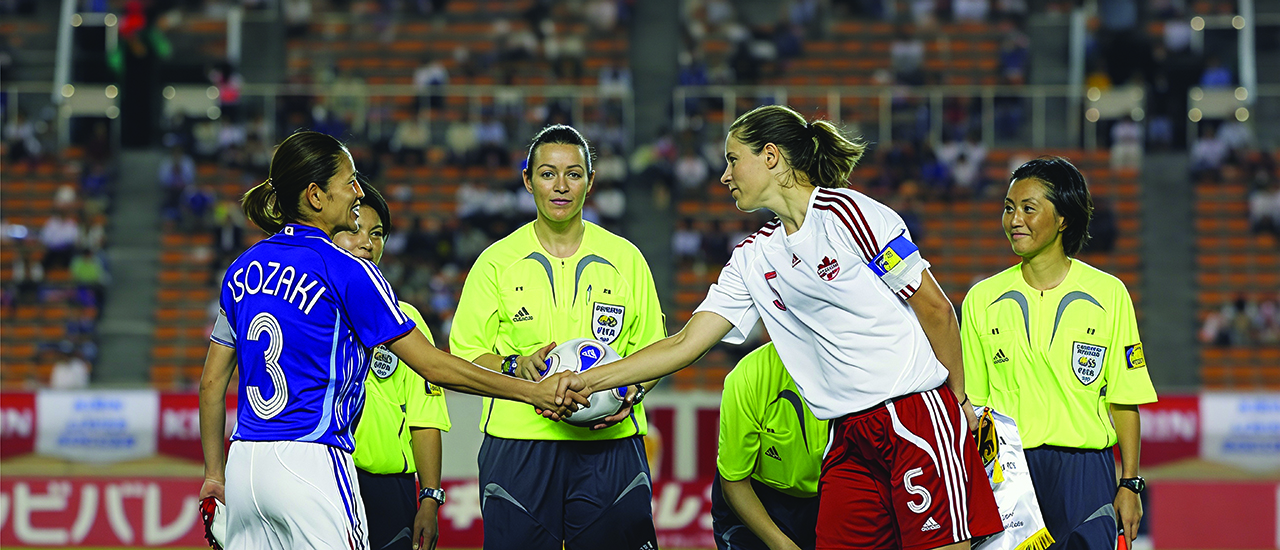
In the Lead With Andrea Neil
Monday, October 5, 2026
In the Lead magazine seeks to inform future leaders, generate global dialogue on leadership and build a community that sees more effective leadership as a prerequisite to building a better world.
It is published by the Buccino Leadership Institute, developing leaders at Seton Hall for over 30 years. This edition reaffirms Seton Hall’s commitment to fostering innovative, ethical and impactful leadership. Stay ahead of the curve — explore the Fall 2026 issue of In the Lead.
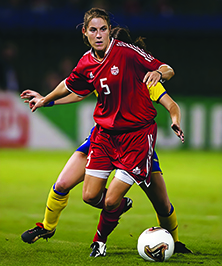
Andrea Neil, a pioneer of Canadian women’s soccer
In the Lead is a conversation with industry leaders on key trends and leadership challenges. In this issue, we spoke with Andrea Neil, a pioneer of Canadian women’s soccer. Over an 18-year national team career from 1990 to 2007, she earned 132 caps — appearances in international competition — and played in four Women’s World Cups. She helped lead Canada to its best World Cup finish in 2003, while also serving as team captain and later as a coach. She discusses what leadership judgment really is, why wisdom is grounded in the heart as much as the mind, and how leaders can separate good judgment from good outcomes.
Andrea Neil, leadership consultant and creator of The Compass of Leadership
Ruchin Kansal (RK): Andrea, thanks for joining us. Leaders are judged by their judgment, and artificial intelligence is complicating how we build it: More information doesn’t mean better decisions. So, to start, how do you define leadership judgment?
Andrea Neil (AN): We tend to think of leadership judgment as an almost purely logical enterprise, and for a lot of people, emotion has no place in it. But for me, leadership judgment is the whole process of making a decision. And when we look at how we actually make decisions, we have to take a holistic view, because we are holistic beings: intellectual and logical, yes, but also emotional, physical, energetic. Even our nervous system plays a role in how we decide.
Our emotions, and not just the sentimental kind some people think leaders can’t have, are the energy that moves us. To be cut off from them means we’re missing part of the picture because emotions like fear can drive our judgment in ways that shrink our capacity. So when I think about leadership judgment in an ethical, holistic way, I’m really thinking about wisdom. Wisdom includes the heart: the ability to ground ourselves in a place that’s neither purely logical nor irrationally emotional, but where our thinking and feeling work together, so we can perceive the context around us and discern the best decision for that moment, for that person or for the group. If we operate from pure logic alone, I don’t think we’re operating at our full capacity as leaders.
RK: I like the construct of leadership judgment as the process of making a decision grounded in wisdom. But we tend to say wisdom comes with age, experience or failure. So there’s a catch-22: How do you make wise judgments when you’re young? Take your own example: After an accident, you switched from badminton to soccer at a young age. How did you make that call, and was it wisdom that drove it?
AN: I was in a motorcycle accident in the Dominican Republic. Before that I’d gone away on a tall ship to try to find myself and make a decision on my path forward — badminton or soccer. Interestingly, it wasn’t the sailing trip that resolved it, it was the accident. In a moment like that, with a real consequence on the line, things suddenly became clear. I nearly lost my leg; I’d gotten gangrene, which is also life-threatening.
In that moment, it became obvious: I chose soccer because I understood it made my heart sing. What drew me toward it was the sense of doing something beyond myself. There’s something different about the collective goals of a team, and that shift changed the course of my life. It taught me to communicate in front of a group, and it began my education in leadership. It also meant doing something uncomfortable because soccer wasn’t the comfortable choice. I was still learning it.
The accident transformed me in other ways too. I had this deeper knowing that I was underachieving academically, coasting through university, not using my intellect. The accident made me realize I wasn’t even scratching the surface of my potential.
I think we often mislabel good things and bad things because it’s frequently in the falling down that we really learn where we’ve erred, or what allows us to thrive.
RK: You’ve tied wisdom to the heart, not just experience, and that led you to soccer. Now let’s flip it. You have been both a player and a coach. How do you apply judgment when it’s not about you, but about the team?
AN: As a player, your focus is on collective goals, but your perception is still largely about yourself within the team. As a coach, that view widens. It’s no longer about developing one player, but about how you build each individual toward a purpose, and then bring those individuals together. You have to understand where every person is coming from, where their gaps are, in order to move them toward both individual and collective goals.
What the accident also taught me is that experience matters because we need contrast to understand what good judgment is and what it isn’t. But wisdom isn't purely cultivated through experience. Experience is a large part of it, but if it were only that, we'd all be wise by now. The deeper, intuitive knowledge that lets us make sound judgment is cultivated not just through information, but through feeling the consequences of our actions.
Take winning, the objective of any sport. How you pursue that matters because you can go after winning in a way that erodes the well-being of the people on your team. That’s where wisdom comes in. Judgment from a purely logical place, without the heart, can exploit and extract without us even realizing it.
RK: You’ve added well-being of others as a dimension of good judgment. This relates to our values. But often there’s a fracture between stated values and how judgment actually plays out. How do you reconcile the two?
AN: That’s really at the core of it. If we think leadership only points outward, and don’t understand that it starts inward, we run into that gap: the words on the wall not meeting the actions after decisions are made. That’s a deep incongruency, and it erodes trust in a leader.
But I’d flip this a little. I don’t think performance and values are ever really in conflict because we’re constantly performing in life, in an interview, in relationships, even brushing your teeth. How well we do something is just inherent. What actually comes into conflict, in moments of pressure that test the words on the wall, are the competing values themselves.
You might say your company stands for integrity, that honesty guides your decisions, and then, when push comes to shove, a success metric, or your own reputation, turns out to matter more. Those are the unsaid values running quietly beneath the surface, driving our actions and decisions without us pausing to ask what actually drove them. We have to do that deeper reflection, every day.
RK: I run an exercise with my students on values. I give them a deck of 100 values and ask them to sort them into “most important,” “important” and “doesn’t matter.” Then I have them narrow the top stack down to 10, then to three. Then I test it: I put them in a crisis, a war, five days without food, a hungry child depending on them, and ask which of those three values survive. Would you say self-knowledge of your values is at the heart of good judgment, that leaders need to get very aware of them so they don’t become blind spots?
AN: Yes, it’s at the heart of it, because those moments of testing will come, through crisis, pressure, uncertainty. It’s like an athlete developing toward an optimal state. You need to know where you want to go and where you now stand, so you know what to move away from.
If we don’t recognize that life will bring resistance, we’re caught off guard. What we’re really talking about, I think, are virtues: trustworthiness, honesty, kindness, courage, moral strength. Values are things we believe are important; virtues are those things lived out, love in action, patience in action. These are what let us thrive as individuals and communities. All discord, I’d argue, begins where love stops — where we stop considering another person as fully as we consider ourselves.
RK: So we’re talking about an internal compass meeting an external environment. But that can sound idealistic, not every leader shows up that way. Many have the urge to dominate, their way or no way. If you’re voting for, watching or trying to influence a leader like that, what do you do? Is it even worth trying?
AN: It’s always worth trying. But before you try to address it outside yourself, you have to look at what’s creating domination within you because what we recognize in others, we often fail to recognize in ourselves.
Domination leads to harm, exploitation and extraction. It’s the belief that I need to be superior, and therefore you need to be inferior. Confronting that in ourselves is actually empowering because there’s endless material to work with: the voice that says you’ll fail, the voice that says my interests, my fears, count more than my neighbor’s.
Think of it like a tree: Our will is the root system. Our will to confront domination, ethically and from a place of virtue, requires developing that root system so the tree can stand against a strong wind. If we don’t confront the vices within ourselves, we develop a weak root system, and we can’t meaningfully confront what’s outside of us either.
RK: We’ve talked about the process, self-awareness, the heart, experience, virtue. But most of the time, judgment gets measured by outcome alone, and the faster the world moves, the more it collapses into just that. How do you balance good judgment against the pressure to deliver, whatever it takes?
AN: I think the answer lies in balancing doing with being. We’re always doing, performing, achieving — that’s living. But we can’t lose sight of the fact that we’re being at the same time as doing. How we do things matters, and so does the underlying motivation.
In sport, the objective is clear: Score one more goal, win. But the laws of the game also carry a spirit around honor: respecting the game, respecting decisions. There’s a deeper purpose baked into the objective itself. Without that respect for fairness and spirit, we’re not playing football anymore, we’re playing fightball.
It’s not just what happens on the field; it’s how leaders bend the rules to benefit themselves, where favoritism, fear and retribution creep in. If we can name that as domination, and recognize where it leads, we can choose in our own decisions which compass points elevate us and which push us down.
RK: Let me play devil’s advocate: The “how” matters because it affects people right now. But fast-forward 500 years, history only remembers the outcome. On that timescale, does the “how” even matter, or should judgment just be about the outcome?
AN: When I read history, I think about impact because written history is only a sliver of what actually happened. I feel the contrast: Lives were affected, courses of history were changed, suffering was created. That’s the domination mindset at work: building hierarchies of whose life is valued more, and whose is valued less.
And I don’t think the “how” disappears into the outcome; it shapes what the outcome becomes. When an institution is built on domination, it keeps reproducing that, so what history records as the result is really the “how,” compounded. I try to imagine, 500 years ago, what was valued, and what the consequences of that were, consequences we can still see as scar tissue in our lives today. You might say ancient history doesn’t touch you, but we’re all living in the same humanity, generation after generation, and the world still isn’t at peace. So what values brought us to this point, inside ourselves, in moments where something in our gut says “this feels wrong” and we do it anyway? That erosion, that lack of integrity, of authenticity, has consequences too, in our health, our relationships with ourselves and with the world.
RK: Fair enough. A couple more questions. First: If you were back in high school or first-year college, what would you tell yourself to get ready for the judgment calls ahead, as team captain, coach, thought leader?
AN: I’d say: reflection and self-awareness. Pause from the doing because it’s only by slowing down that we give ourselves room to connect with our hearts and understand what really matters.
Think of a boat just 1 percent off course. Left uncorrected, that 1 percent takes you somewhere entirely different over time. Developing an orientation, a compass of the heart, even at a young age, brings so much more clarity to counter the confusion around us and helps chart a determined course. We need clarity to see, a grounded place to feel and decide from, so we have real discernment. And then, will. All of this takes energy and work.
RK: On my calendar, I block off “focus time” every day, though my son teases me and calls it “goof-off time.” He’s not wrong, and it’s exactly what I tell my students to do: 30 minutes of doing nothing, no phone, just being. Last question: What should I have asked you that I didn’t?
AN: We tend to misunderstand leadership as just gaining more information, more hard skills. There’s a misconception that soft skills are “soft,” they’re not. Hard skills used to mean hardware; soft skills meant everything else. But it’s the fundamental thing, our relationship with ourselves, that lets us relate to other people and situations, and gives us the compass points to ask: Can I orient toward virtue? We can still win, still earn, still create abundance, but do it in a way that reduces the harm we cause ourselves and others along the way. We go first, ourselves.
RK: Our research shows people trust a leader when they see capability (the hardware) alongside integrity and benevolence (the so-called soft skills), and that’s when judgment really earns trust.
AN: We didn’t touch on the fact that we’re all going to fail. That’s actually where trust gets built or broken because none of us are all-knowing. So what do we do when the ball gets dropped, when mistakes happen? That moment can build integrity or break it, depending on whether it creates pride and a lack of humility, or genuine accountability. The incongruency between what leaders say and what they do gets tested most in these moments, setbacks, failures, things not going to plan, and whether we’re willing to acknowledge our role in it first.
That’s where the real trade-off shows up. Protecting our own standing in that moment can mean treating others as resources rather than as people. That’s when people get hurt.
RK: I’d add one more word to that: courage.
AN: Courage, the root word is heart. Without heart, we can’t go forward because there will be vulnerability and fear, and we can’t know what the future holds. What’s the motivating force that keeps us moving forward anyway? It comes from the heart.
RK: One of my students recently gave me a great example of good judgment. They hadn’t done what they were supposed to, and instead of coming to me to complain about a bad grade, they owned it: admitted the mistake and proposed solutions to address it. That, to me, was strong judgment at a young age.
AN: That’s meaningful action, and that’s how we actually learn. I think many leaders mistake surface-level change, shifting a policy or a new procedure, for meaningful change. Real change means questioning things at a deeper level: What was the environment that created this problem in the first place? That’s where the real work is, resolving it at the root, rather than just pushing the same problem from one place to the next.
RK: Thank you so much, Andrea.
AN: Likewise, thank you for your wisdom and your care. I can tell you take trustworthiness, benevolence and care seriously, and honestly, those are the missing pieces out there. We need leaders, anyone willing to take up the mantle, to become more self-aware.
At the end of the day, none of us live forever, and this will be our body of work: how we made people feel, how we accomplished it. We have to reckon with that eventually, so why not contemplate it now, and put our lives on a better course while we still can?
Categories: Athletics, Business