'Diplomacy Is Rarely About Quick Solutions': Students Reflect on the 2026 UN Intensive Summer Seminar
Monday, August 10, 2026
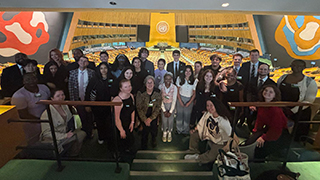
Students at UN Summer 2026 Intensive Seminar
The 2026 United Nations Intensive Summer Seminar brought together 30 students and professionals from 12 countries for a week of conversations about the challenges, possibilities and future of multilateral cooperation. The seminar attracted participants with a wide range of academic, professional and cultural backgrounds, including undergraduate and graduate students as well as mid-career professionals whose work or interests intersect with international affairs.
Held from June 8 to 12 at the Church Center across from United Nations Headquarters in New York City, the seminar offered participants direct engagement with diplomats, UN officials, civil society representatives and other international affairs professionals. Half of this year’s participants were Seton Hall students, while others came from universities, companies and government institutions elsewhere in the United States and abroad. Participants heard from 25 speakers from across the UN community and took part in an official visit to United Nations Headquarters. Sessions explored UN80 reform, multilateralism, civil society engagement, the Pact for the Future, the Declaration on Future Generations and United States-UN Relations, among other topics.
Courtney B. Smith, Ph.D., dean of the School of Diplomacy and International Relations, led the seminar alongside Troy Wolfe, senior director for partnerships and special initiatives at the United Nations Association of the United States of America.
This year’s seminar took place as the United Nations faces financial constraints, geopolitical divisions and growing demands to respond to increasingly complex global challenges. According to Dean Smith, these circumstances contributed to a timely and substantive week of discussions. “The UN is under a lot of financial pressure now,” Smith said. “And yet the issues that the international community needs to address are getting more and more complicated.”
While speakers spoke candidly about the pressures facing the international system, Dean Smith emphasized that the discussions were not defined by pessimism. Participants heard about global solutions and the continued dedication of professionals working throughout the UN system. The central challenge, Smith explained, is building the political will and securing the resources necessary to turn solutions into meaningful action.
For Seton Hall students, the seminar offered an opportunity to connect their classroom learning and career aspirations with the daily work of international institutions. Graduate student Caitlin Wilson identified Stéphane Dujarric, spokesperson for the UN secretary-general, as one of the speakers who stood out to her during the week. Dujarric discussed how his team prepares for daily press briefings covering current events and UN developments from around the world. He also reflected on working under different secretaries-general and maintaining balance in a fast-paced communications role. “The program definitely reinforced my belief in the UN as an imperfect, yet essential, organization,” Wilson said.
The seminar also encouraged her to think more critically about how institutional reforms could be achieved despite geopolitical tensions. Wilson, who has wanted to work at the United Nations since she was young, said the experience strengthened her commitment to pursuing that goal. She also valued the opportunity to learn alongside participants from outside Seton Hall. “Getting to hear a range of perspectives from the speakers as well as the participants added to my experience by introducing diverse worldviews into the discussions,” Wilson said.
For graduate student Marta Savruk, the seminar offered a broader understanding of the work taking place throughout the UN system. As a student from Ukraine studying diplomacy and international law, she found the conversations about accountability, peacebuilding and multilateral cooperation especially meaningful because of their connection to the challenges affecting her country.
Before the seminar, Savruk said she primarily viewed the United Nations through the work of the Security Council and the framework of international law. Conversations with professionals from different parts of the organization expanded that perspective. She came away with a greater appreciation for the work taking place behind the scenes in areas including sustainable development, climate policy, youth engagement and humanitarian coordination. The experience also strengthened her goal of pursuing a career in international organizations by making that professional path feel more tangible.
“One takeaway I’ll carry with me is that diplomacy is rarely about quick solutions,”
Savruk said. “It often involves patient, long-term collaboration and while that work
may not always be visible, it can still have a meaningful impact.”
Through direct interaction with practitioners and participants from different backgrounds,
the UN Intensive Summer Seminar allowed students to move beyond a classroom understanding
of international affairs. This year’s program highlighted participants’ commitment
to finding solutions and reinforced the importance of international cooperation in
addressing challenges no country can solve alone.
For more information about the UN Intensive Summer Seminar see the program's official page.
Categories: Nation and World