A Diplomacy Alumna’s Lead in Human Rights Advocacy
Thursday, May 7, 2026
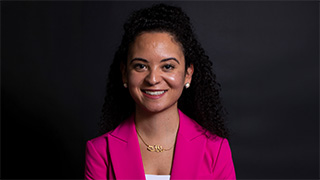 Malaak Jamal ’15, is an alumna of the graduate program at the School of Diplomacy and International Relations. Jamal is currently serving at the Human Rights Foundation (HRF) as director of Policy and Research, where she oversees research programs and analyzes
political regime developments in countries under authoritarian rule. She works alongside
the Chief Legal and Policy Officer and Chief Advocacy Officer to ensure that the work
produced by the Human Rights Foundation (HRF), including the organization’s research,
impact litigation, advocacy, campaigns, programs and events, is in line with its mission
statement.
Malaak Jamal ’15, is an alumna of the graduate program at the School of Diplomacy and International Relations. Jamal is currently serving at the Human Rights Foundation (HRF) as director of Policy and Research, where she oversees research programs and analyzes
political regime developments in countries under authoritarian rule. She works alongside
the Chief Legal and Policy Officer and Chief Advocacy Officer to ensure that the work
produced by the Human Rights Foundation (HRF), including the organization’s research,
impact litigation, advocacy, campaigns, programs and events, is in line with its mission
statement.
When Jamal graduated from the School of Diplomacy, she carried with her not only a strong academic foundation but also a deep commitment to advancing justice and human rights advocacy. Today, in her role at the HRF, Jamal is turning her commitment to global justice into meaningful change and advocacy.
HRF is a globally known, prestigious and preeminent human rights organization that has produced many impactful research and policy reports and advocacy-oriented conference series, such as the Oslo Freedom Forum, a conference series designed to connect activists with the wider public, media, technologists, philanthropists, academics and policymakers, among other diverse audiences. One of Jamal’s responsibilities includes managing the speaker selection process for Oslo Freedom Forum, where it hosts human rights activists all around the world and empowers their voices. Chemi Lhamo is a recent example that Seton Hall also hosted as part of the College Freedom Forum, at the heart of campus in New Jersey.
Reflecting on her time at Seton Hall, Jamal shared that the School of Diplomacy helped her to focus on her passion for democracy and human rights. During her graduate studies, she specialized in human rights, international law and post-conflict state reconstruction and sustainability. Jamal’s journey in global justice began on campus, where her coursework and experiential learning opportunities exposed her to the complexities of the most pressing global issues. Jamal received a comprehensive curriculum combining international law and diplomacy, providing an immersion into global advocacy.
Jamal shares that a career in human rights has always been a goal and that her education at Seton Hall and her internship at HRF provided valuable guidance on where to start. Prior to her internship at HRF, she participated in a summer internship at the Issam Fares Institute for Public Policy and International Affairs based at the American University of Beirut in Lebanon, where she combined coursework with field experience. Hands-on experiences and leadership roles on campus paved the way for Jamal. She was also the associate editor of The Journal of Diplomacy and International Relations at Seton Hall, where she honed her analytical writing and research skills.
Since graduating in 2015, Jamal’s career has moved forward, and she has played a vital role in producing and leading on policy development. Among the most recent examples of this has been overseeing the recent launch of HRF’s flagship research project, the Tyranny Tracker, which serves as the foundation of its work, and publication of a Journal of Democracy piece outlining distinct features of its methodology. Her work often involves navigating challenging political environments while ensuring human rights and international law remain at the forefront of political discussions. Jamal shares, "Despite the odds, you need to believe that you are advancing democracy. Be positive and push forward, no matter what challenges you face."
Jamal’s story exemplifies how hard work and dedication can translate into meaningful, impactful leadership.
Jamal offers advice for students in the School of Diplomacy who want a career in human rights and democracy promotion, "Think about what you are good at and how those strengths can be used to bring attention to important issues and the gaps that exist in diplomacy. Sometimes the best place to start is with something small, whether that’s engaging with an event on campus or contributing to a school’s journal in a practical way. For graduates, it’s important to take opportunities as they come; having a vision and a plan helps, but so does staying open to what you learn along the way, including guidance from professors from the School of Diplomacy." Jamal also cited internships as an important way of gaining hands-on experience, "Put yourself out there, take advantage of opportunities like Seton Hall’s proximity to New York City, and don’t hesitate to reach out to people. Above all, stay true to your values and principles, stand by your research and writing and be yourself."
Jamal’s story exemplifies a true leader who keeps human rights front and center, values international law and highlights the importance of leveraging the opportunities offered at the School of Diplomacy to the fullest.
Categories: Nation and World