Seton Hall Students Discuss Big Economic Ideas on Campus and in Nebraska
Thursday, April 30, 2026
 Why did Western European countries grow before the rest of the world? How do private
property rights influence economic outcomes? How do entrepreneurs contribute to economic
growth? Economists have been debating these questions relentlessly over the past 250
years. They are still at the top of the research agenda today, and economists such
as Daron Acemoglu, Joel Mokyr and others have received the highest awards for their
innovative answers.
Why did Western European countries grow before the rest of the world? How do private
property rights influence economic outcomes? How do entrepreneurs contribute to economic
growth? Economists have been debating these questions relentlessly over the past 250
years. They are still at the top of the research agenda today, and economists such
as Daron Acemoglu, Joel Mokyr and others have received the highest awards for their
innovative answers.
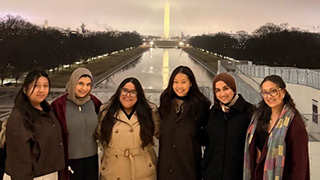
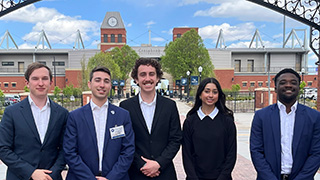
This semester, students at Seton Hall University had the opportunity to discuss these questions and debate the answers of the brightest economists through two different unique learning experiences. The Economics Reading Group met five times to read and discuss Joel Mokyr’s A Culture of Growth, a book that was instrumental in earning its author the Economics Nobel Prize in 2025. And over two days in April, five students visited Creighton University in Omaha, Nebraska, where they debated economic issues with students from six other universities.
The Reading Group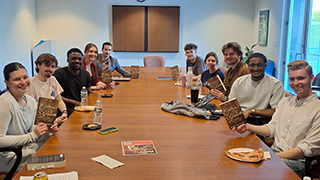 The Economics Reading Group was led by Danielle Zanzalari, Ph.D., and Vincent Carret, Ph.D., two assistant professors in the Department of Economics and Legal Studies. Both felt that it was necessary to engage students beyond the classroom, to make
them discover how economics shapes the world around us. Thanks to the generous support
of our Stillman donors, they were able to create an economics reading group of nine
students, which met five times for two hours throughout the semester, beginning each
time with a 30-minute dinner.
The Economics Reading Group was led by Danielle Zanzalari, Ph.D., and Vincent Carret, Ph.D., two assistant professors in the Department of Economics and Legal Studies. Both felt that it was necessary to engage students beyond the classroom, to make
them discover how economics shapes the world around us. Thanks to the generous support
of our Stillman donors, they were able to create an economics reading group of nine
students, which met five times for two hours throughout the semester, beginning each
time with a 30-minute dinner.
The students unanimously found the reading group much more engaging than regular lectures in the classroom, and appreciated the way in which this discussion format provided a space where they were motivated to engage with each other and try out their ideas. Beyond the economic knowledge they gained through the group, the participants emphasized the contribution of the discussion to their critical thinking and communication skills. One participant emphasized how “getting to experience these high-level, intellectually engaging conversations has been incredibly impactful. They've pushed me to think more critically, consider new perspectives and engage more deeply with complex ideas.”
As the discussion centered on the role of economic and cultural entrepreneurs in generating economic growth, students began to appreciate more deeply the role of entrepreneurship in our society. As one of the participants relates, “the book we read spoke a lot about cultural entrepreneurs: those who were able to change something about society. This was done because they had the tools to question everything. This reading group was so spectacular because it gave students an opportunity to tear apart economic concepts: what is really fundamental for a culture of growth? After this experience, I feel much more equipped to express my opinions and become a catalyst for change.”
The Humanomics Conference in Nebraska
Experiences that engage students into intellectual material are central to their learning
opportunities. Carret, who joined Seton Hall after two years in Omaha, where he was
visiting professor at Creighton University, had witnessed first-hand how the Center
for Economic Inquiry at Creighton was able to impact students’ journeys through its
programs. When they invited him back to attend their annual Humanomics conference,
during which students from half a dozen schools discuss readings related to economics
and humanities, he selected five students that would represent the breadth and depth
of the Seton Hall community.
To prepare for their trip to Omaha, the five students had to read over 150 pages of material written by world-renowned economists. They departed for the Cornhusker State on April 17, and the Humanomics conference kicked off with a reception and keynote lecture in the afternoon, followed by a social dinner.
On Saturday, the students were spread in five different rooms where they discussed the readings over three sessions. Anisa Sheikh, a sophomore in the business school who is on a pre-med track, liked the seminar, “because listening to different viewpoints helped me better understand how people’s backgrounds shape their decisions.” For future business leaders, the experience of talking to and convincing others is an essential part of a good education.
The students also made new connections; Daniel-Martin Cantave, a junior majoring in quantitative economics and econometrics, appreciated the “opportunity to network with other students and faculty members while discovering a new city.” Omaha, the largest city in Nebraska, has a lot to offer, and on Saturday afternoon Seton Hall students got to visit the world-famous Henry Doorly Zoo, one of the largest in the world, before the closing dinner on Saturday.
Overall, students and faculty valued the opportunity to meet outside the classroom in order to discuss important ideas and create new connections. The economics faculty will expand these opportunities next year with two reading groups - one meeting in the fall, one in the spring. Students who are interested in these opportunities or want to learn more about other opportunities offered by the Department of Economics and Legal Studies should reach out to Danielle Zanzalari at danielle.zanzalari@shu.edu or Vincent Carret at vincent.carret@shu.edu.
Categories: Business, Nation and World